Welcome to Boston, MA: An Essential Guide for Young Families
Explore Boston’s village-like family neighborhoods, from West Roxbury’s 91% graduation rate to MBTA access, parks, and homes with yards.
Boston, MA
Region
2
Villages
# Welcome to Boston, MA: The Ultimate Neighborhood Guide for Young Families
Boston is one of those rare cities where centuries of history and the everyday rhythms of family life fit together without effort. For young families, the draw goes beyond the brownstones and the swan boats. It's the quiet, tree-lined pockets where kids learn to ride bikes, where neighbors actually know your name, and where a great school is often just a short walk from your front door. Think of this guide as your starting point for understanding what it really means to raise a family here.
Is Boston, MA a Good Place to Raise Young Families?
Yes — Boston is a genuinely family-friendly city, especially in its residential neighborhoods, where safety scores run well above the citywide average and community life is active and welcoming. The key is knowing which pockets suit the young-family lifestyle, and this is where the numbers tell a reassuring story.
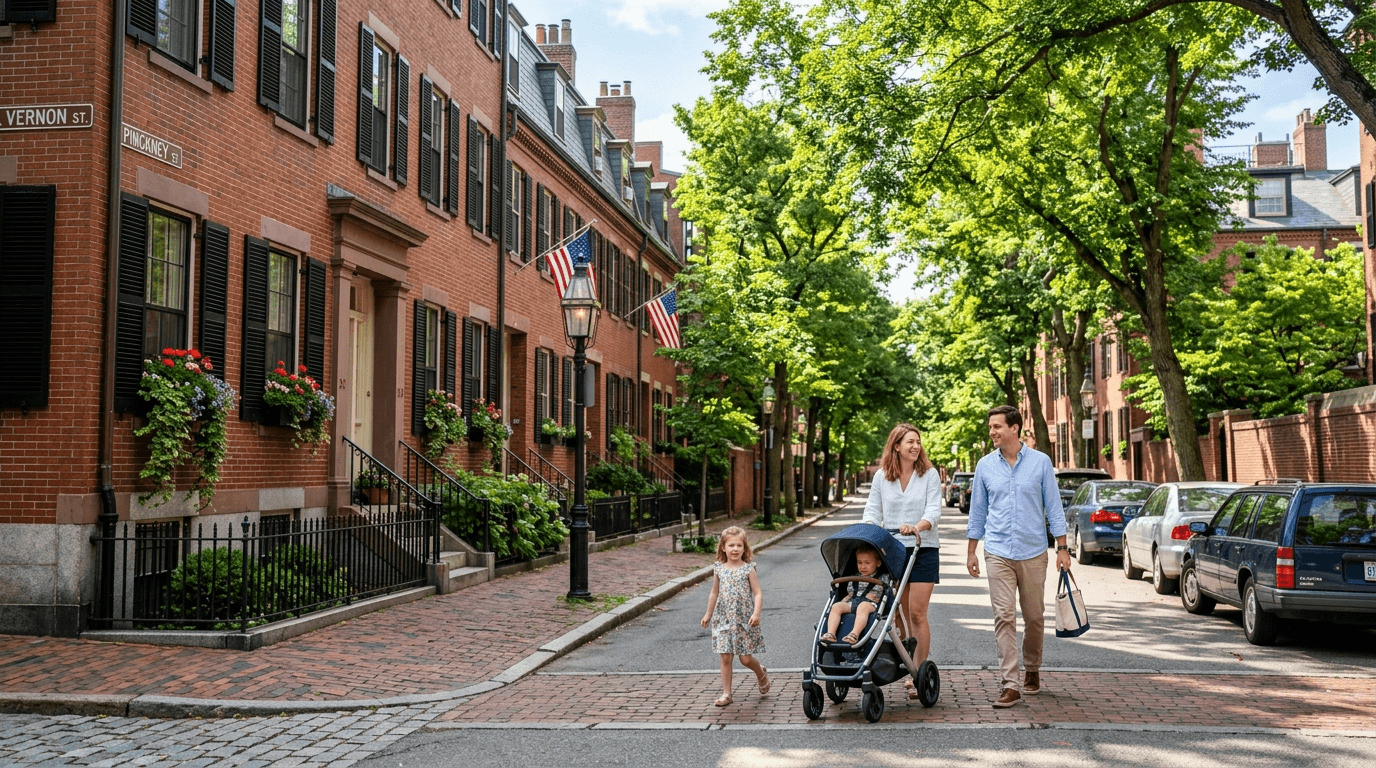
When I walk clients through neighborhoods like West Roxbury, Roslindale, and Charlestown, the first thing they notice is the pace. These are quiet, stroller-friendly streets — the kind where you'll pass three other families on an afternoon walk to the park. It feels different from the dense, always-on energy downtown. Picture a village tucked inside a city rather than an urban core.
Safety is almost always the first question parents ask me, and the data backs up what you feel on the ground. Compared to the citywide average, West Roxbury stands out dramatically, measuring 94% safer than the city average, with Roslindale close behind at 81%. East Boston (69%), Charlestown (63%), and Hyde Park (56%) all land comfortably on the safer side of the ledger too.
Neighborhood Safety Relative to Boston Average
Safety perceptions and reported safety metrics are central to family decision-making. West Roxbury and Roslindale stand out among the listed neighborhoods on this relative safety measure.
Citywide trends are moving in the right direction as well. Boston's homicides year-to-date dropped to 5 in 2026 from 13 the year before, and robberies fell from 285 to 243. For families comparing metros, Boston's violent crime rate runs about 31% lower than Philadelphia's — a handy benchmark when you're weighing where to plant roots.
What Are the Best Family Homes and Neighborhoods in Boston, MA?
Boston's family-friendly neighborhoods offer everything from classic brick rowhouses to detached Victorian and colonial single-family homes, with the most family-oriented pockets — West Roxbury, Roslindale, and Charlestown — sitting at more accessible price points than the luxury core. You get real architectural character without paying Back Bay prices.
In the historic districts, you'll find the postcard version of Boston: brick brownstones with original fireplaces, high ceilings, crown molding, and bay windows. Move into the outer residential neighborhoods and the housing shifts toward detached single-family homes and two-families with actual yards — the compact, manageable outdoor space that growing families love. Lot sizes are modest by suburban standards. A typical family home might sit on around 5,000 sqft, but for a city, that private green space is gold.
Here's how five popular family neighborhoods compare on price and long-term appreciation:
Family Neighborhood Housing Snapshot
A family-focused headline snapshot of housing costs and longer-term appreciation in five Boston neighborhoods often highlighted for young families. Because the metrics mix dollars and percentages, this is best shown as a snapshot rather than a standard chart.
A few things stand out from that snapshot. Hyde Park is the most affordable entry point on this list, with a median home price around $433,932. East Boston has been the fastest-appreciating at 50%, followed closely by Charlestown at 43% and Roslindale at 42% — strong signals for families thinking about building equity over time.
Citywide, the market has cooled from its frenzy. Boston's median listing price sat around $949,000 in early 2026, and homes are taking a median of 73 days to sell. That means buyers finally have room to breathe and make thoughtful decisions instead of firing off same-day offers. The family sweet spot still sees competition, though — West Roxbury single-families in the $800K–$1.2M range have been closing at 106.3% of asking price. And if you're coming from a more urban market like Cambridge, Boston's residential neighborhoods offer that quieter village feel our family clients consistently gravitate toward.
How Are the Schools in Boston, MA for Young Families?
Boston Public Schools serves roughly 47,000 students across a large, diverse system, and graduation outcomes vary meaningfully by neighborhood — so school research should be part of your neighborhood search from day one. The good news: several family neighborhoods post strong, well-above-average graduation rates.
To understand the scale of the system you're buying into, it helps to see enrollment across every grade, from pre-K through senior year:
Boston Public Schools Enrollment by Grade
A districtwide look at Boston Public Schools enrollment by grade for 2025-26, useful for families trying to understand the scale of the school system from pre-K through high school.
That's a big, layered district — one where 82 languages are spoken and students come from 140 countries. Districtwide, the Class of 2025 graduated at 81.3%, up sharply from 70.7% a decade earlier, so the overall trajectory is encouraging.
Neighborhood graduation rates cover a wide range, though — from a low of 65% in East Boston to a high of 91% in West Roxbury:
High School Graduation Rates by Neighborhood
School outcomes are a top concern for young families. This chart compares reported high school graduation rates across five family-oriented Boston neighborhoods, with West Roxbury and Charlestown leading the group.
West Roxbury (91%) and Charlestown (89%) lead this group, with Roslindale (86%) and Hyde Park (83%) close behind. East Boston's 65% is the outlier on the low end, and it deserves an honest conversation. East Boston is one of the fastest-growing, most affordable, and fastest-appreciating neighborhoods on our list, but its school outcomes lag the others here. Families drawn to its value should pair that enthusiasm with a close look at specific schools, charter options, and BPS's citywide "choice" enrollment.
One practical note: BPS is actively reconfiguring its footprint, moving from 109 schools in 2025-26 toward roughly 104 in 2026-27 as enrollment shifts. I always tell parents to confirm a specific school's status for the exact year their child will enter, rather than leaning on a neighborhood's general reputation.
Where Do Families Gather in Boston, MA?
Families in Boston gather around the city's parks, greenways, libraries, and family-focused cultural institutions — with the Boston Common, the Public Garden, and neighborhood parks serving as the everyday backbone of community life. These are the places where casual friendships between parents (and their kids) take root.
The classics earn their reputation. The Boston Common and Public Garden are unbeatable for open-space play, picnics, and the beloved swan boat rides that become a childhood ritual. Downtown, the Rose Fitzgerald Kennedy Greenway threads a ribbon of fountains, carousels, and lawns through the heart of the city — a scenic, kid-friendly stretch that's perfect for burning off energy. And Norman B. Leventhal Park in Post Office Square offers a green oasis for families spending a day in the Financial District.
Out in the residential neighborhoods, the gathering spots feel more local. Charlestown families anchor around Bunker Hill Monument and Park, while West Roxbury's Millennium Park is a favorite for weekend outings. The neighborhood libraries host weekly story times that become a reliable rhythm for parents of little ones, and the Boston Children's Museum remains a rainy-day institution.
It's also worth mentioning what surrounds these neighborhoods. Boston is home to Boston Children's Hospital, ranked the #1 children's hospital in the U.S. by Newsweek in 2026 and on the U.S. News Honor Roll every year since 2007. For young families, having world-class pediatric care minutes away is a reassurance that's hard to overstate.
How Is the Commute From Boston, MA for Working Parents?
Commuting in Boston is genuinely manageable for working parents thanks to the MBTA's Green, Red, and Orange Lines, extensive bus routes, and highly walkable neighborhoods that cut down on car dependence for daily errands. For a major city, a surprising amount of family life here happens on foot.
The neighborhood you choose shapes your commute. Charlestown families lean on the Orange Line and bus routes into downtown. East Boston sits on the Blue Line with quick access to the airport and the harbor. And the southern neighborhoods — West Roxbury, Roslindale, and Hyde Park — are well served by the Commuter Rail's Needham and Fairmount lines, plus Orange Line connections at Forest Hills. That Commuter Rail access is a real advantage for parents who want a quieter, more residential home base but still need to be downtown for work.
Walkability is the quiet luxury here. In Roslindale Village or along Charlestown's main streets, you can handle groceries, coffee, and school drop-off without ever starting the car. Boston drivers do lose about 79 hours a year to traffic — but congestion actually improved about 10% recently, and the whole point of choosing a transit-connected neighborhood is to leave that headache behind. Many parents I work with start the morning with a quick coffee run at a local spot before catching the train, and never think twice about parking.
Compared to the denser, pricier core of a market like Cambridge, Boston's family neighborhoods give you a rare combination: real transit access, walkable daily errands, and streets quiet enough for kids to grow up on. That balance — historic charm, strong schools in the right pockets, above-average safety, and a genuinely connected daily commute — is exactly why so many young families make Boston home.
Thinking about a move within Greater Boston? The right neighborhood comes down to how the numbers line up with your family's priorities — schools, safety, commute, and long-term value. I'm always happy to walk through the data with you and help you find the pocket of the city that fits.
Yes. Boston, MA is especially family-friendly in residential neighborhoods such as West Roxbury, Roslindale, Charlestown, Hyde Park, and East Boston. These areas offer quieter streets, active community life, parks, libraries, and access to major family resources like Boston Children’s Hospital.
What are the best neighborhoods in Boston, MA for young families?
West Roxbury, Roslindale, and Charlestown stand out for young families because they combine residential streets, strong graduation outcomes, and family-oriented housing. West Roxbury is 94% safer than the citywide average and has a 91% graduation rate, while Charlestown has an 89% graduation rate and Roslindale has an 86% graduation rate.
What types of homes can families find in Boston, MA?
Boston, MA offers classic brick brownstones, rowhouses, detached Victorian and colonial single-family homes, and two-family homes. In outer residential neighborhoods, families are more likely to find detached homes or two-families with modest yards, while historic districts are known for brownstones with architectural details like fireplaces, high ceilings, crown molding, and bay windows.
What is the most affordable family neighborhood in Boston, MA?
Hyde Park is the most affordable family-oriented neighborhood listed, with a median home price around $433,932. Citywide, Boston’s median listing price was about $949,000 in early 2026, and homes were taking a median of 73 days to sell, giving buyers more time than during the hottest market periods.
How are the schools in Boston, MA for families?
Boston Public Schools serves roughly 47,000 students across a diverse district where 82 languages are spoken and students come from 140 countries. Districtwide, the Class of 2025 graduation rate was 81.3%, up from 70.7% a decade earlier.
Which Boston, MA neighborhoods have the strongest school outcomes?
Graduation rates vary significantly by neighborhood. West Roxbury leads at 91%, followed by Charlestown at 89%, Roslindale at 86%, and Hyde Park at 83%; East Boston is lower at 65%, so families there should closely review specific schools, charter options, and BPS citywide choice enrollment.
How is the commute in Boston, MA for working parents?
Boston, MA has strong transit options for working parents, including the MBTA Green, Red, Orange, and Blue Lines, extensive bus routes, and Commuter Rail access. Charlestown uses the Orange Line and buses, East Boston is served by the Blue Line, and West Roxbury, Roslindale, and Hyde Park connect through the Needham and Fairmount Commuter Rail lines and Orange Line access at Forest Hills.
Where do families spend time in Boston, MA?
Families gather at Boston Common, the Public Garden, the Rose Fitzgerald Kennedy Greenway, neighborhood parks, libraries, and the Boston Children’s Museum. Local favorites include Bunker Hill Monument and Park in Charlestown and Millennium Park in West Roxbury.