We're AD Advisors, a Brookline, MA real estate team led by Arthur Deych, serving buyers, sellers & investors across Greater Boston. Let's find your next move. Serving Brookline, Winthrop, Norwood, Watertown, Waltham, Revere, Medford, Ashland, Framingham, Dedham, Newton, Somerville, Needham, Boston, Cambridge and Westwood, MA.
Somerville, MA
Region
In July 2026, the median sale price for homes in Somerville, MA was $1,248,900, up 13.5% from a year earlier.
Somerville has quietly become the neighborhood young professionals name when they want Boston's energy without the sterile feel of a downtown high-rise. It's dense, walkable, and full of opinions—a place that wears its personality out in the open. Here's how the neighborhood actually works: the vibe, the housing stock, the gathering spots, and the commute, from someone who tours these streets every week.
What Is the Vibe Like Living in Somerville, MA?
Somerville ranks among the most energetic, high-density urban neighborhoods in the entire Boston metro. With a population density near 19,921 residents per square mile and a median age of just 30.9 (compared to 40.1 statewide), it skews young, social, and car-light.
This is a place that stays busy on a Tuesday night. The independent arts, dining, and craft-beer scene runs genuinely deep—the city counts roughly 392 restaurants, bars, and coffee shops, and most residents have around six dining options within a five-minute walk. When I'm walking clients through neighborhoods like Union Square or Davis Square, the first thing they notice isn't a specific listing. It's the sound. Live music spilling out of a venue, a line at a donut shop, people biking everywhere.
There's also an intellectual undercurrent here you don't find in most inner-ring cities. With Tufts University anchoring the west side and Harvard and MIT a short hop away in Cambridge, the community blends grad students, tech workers, artists, and researchers. That mix shows up everywhere—from the taproom conversations at Remnant Brewing in Bow Market to the weekend crowds at the Somerville Community Growing Center .
A few grounding numbers on quality of life:
•Overall community rating: 4.32 out of 5 across 144 reviews
•Violent crime rate: 0.7 per 1,000—well below the national average of 3.6 per 1,000
•Median household income: $120,778—considerably above the national average of $74,580
The honest caveat: residents themselves describe the housing market here as being in "crisis," and rising gentrification comes up again and again in local reviews. Somerville's popularity is exactly why it's expensive—which brings us to the real estate.
What Are Condos and Townhomes Like in Somerville, MA?
Somerville is fundamentally a condo-and-multi-family town, not a single-family one, and for young professionals, that's usually the right fit. The city has 17,257 residential parcels, and 66% of households are renter-occupied versus 34% owner-occupied. So most of the for-sale action for first-time buyers lives in the condo segment.
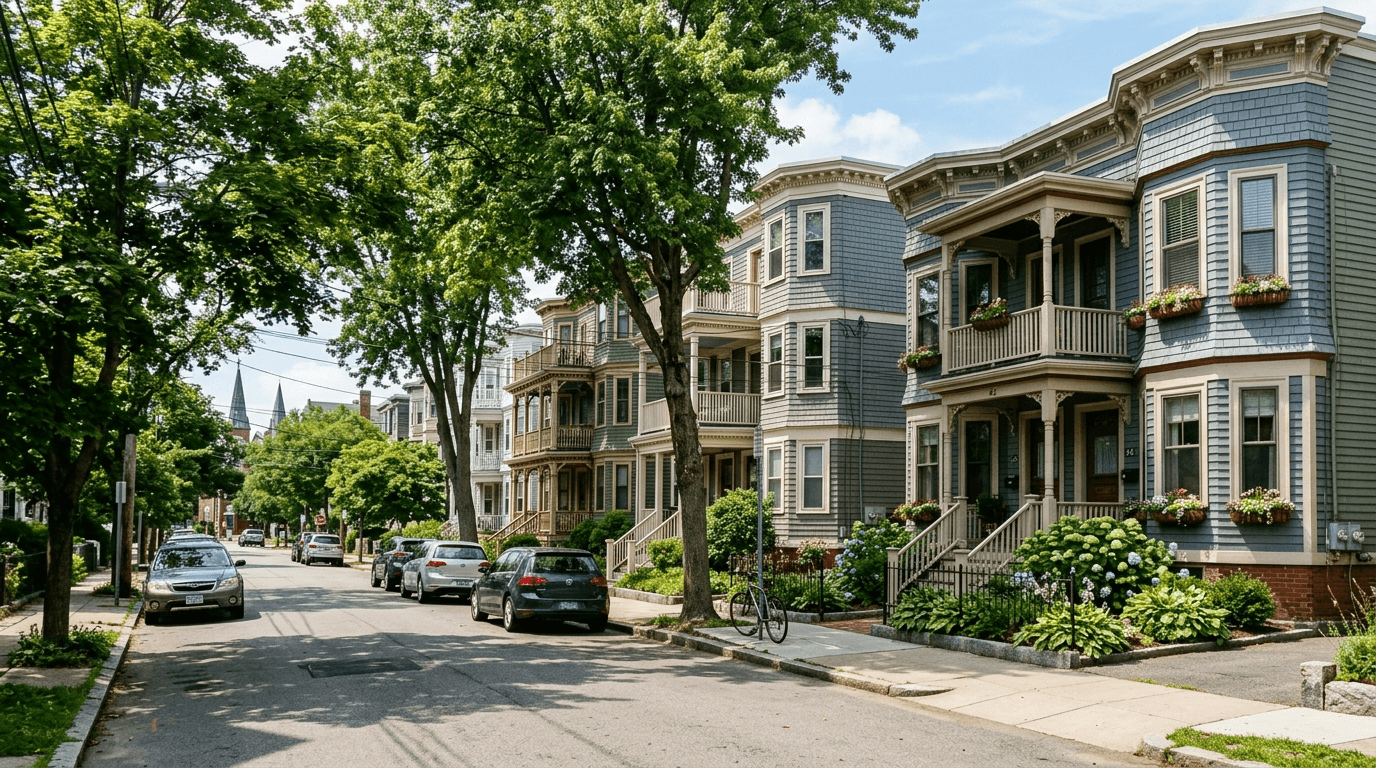
The defining housing type here is the classic New England triple-decker, many of them meticulously converted into two- and three-level luxury condos. Alongside those, you'll find a steady stream of sleek, newly built mid-rise developments with rooftop decks and smart-home features—a market that has exploded historically, with condo units growing 323% between 2000 and 2009.
Here's where the market stands right now, using primary MLSPIN sold data:
Condos / Townhouses (as of May 2026):
•Median sold price: $922,500
•Median days on market: 21 days
•Months of supply: 8.4 months across 351 active listings
Single-Family (as of May 2026):
•Median sold price: $1,558,000
•Median days on market: 22 days
•Months of supply: 5.9 months
Multi-Family (as of May 2026):
•Median sold price: $1,304,000
•Median days on market: 26 days
•Months of supply: 3.9 months
The nuance I always explain to buyers: even though condos show 8.4 months of supply—which on paper looks like a comfortable buyer's market—the well-priced, well-located units still move in about three weeks. That supply cushion sits in the harder-to-move inventory. The good stuff goes fast. Multi-families, by contrast, are the tightest segment in town at just 3.9 months of supply, because investors and owner-occupants fight over them.
Somerville 2026 Housing Market Snapshot
A quick-read profile of Somerville’s mid-2026 housing market, highlighting the city’s high condo activity and premium single-family pricing.
A note on the snapshot above: the blended and condo figures shown come from a secondary June 2026 dataset, which reports the condo median at $879,900. The primary MLSPIN sold data I lead with above puts the May 2026 condo median at $922,500—treat that as the more precise transaction figure, and read the snapshot as a broader directional overview.
Compared with its neighbors, Somerville sits just below Cambridge on assessed value, though well below Cambridge's stratospheric averages—useful context if you're weighing inner-core options.
Assessed Value Comparison: Somerville vs. Nearby Markets
Somerville sits just below Cambridge on median assessed value, while Cambridge’s average assessment is far higher—useful context for buyers comparing inner-core options.
Somerville
Cambridge
Arlington
Somerville sits just below Cambridge on median assessed value, while Cambridge’s average assessment is far higher—useful context for buyers comparing inner-core options.
For renters weighing whether to keep leasing or buy, the math is real: the average Somerville rent runs $3,474, with 63% of rentals priced at $3,000+. Costs climb steeply as you add bedrooms.
Average Somerville Rent by Apartment Size
Rental costs climb sharply from studios to two-bedrooms, reinforcing why many young professionals weigh roommates, commute access, and neighborhood fit together.
Rental costs climb sharply from studios to two-bedrooms, reinforcing why many young professionals weigh roommates, commute access, and neighborhood fit together.
Lot sizes are compact, which is a feature, not a bug, for busy professionals. Union Square lots often sit under 3,000 sq ft; Spring Hill and Magoun Square run 3,000–5,000 sq ft; Ball Square and Teele Square land around 4,000–7,000 sq ft; and West Somerville and Prospect Hill can reach 4,000–8,000+ sq ft. Small yards mean lock-and-go convenience—exactly what a lot of my younger buyers want.
One line item to budget for: condo association fees. Across the Boston metro, mean monthly HOA/condo fees average around $425, and condo owners nationally typically pay $300–$400/month. Always ask what those fees cover before you fall in love with a unit.
What Are the Best Areas and Gathering Spots in Somerville, MA?
Somerville organizes itself around a handful of squares, and each one has a distinct personality. If you're deciding where to plant yourself, start with the hub that matches your rhythm.
Davis Square is the cultural anchor of the west side—home to the historic Somerville Theatre, live music, and iconic casual dining. It's also the most walkable, bikeable corner of the city (more on the numbers below). Condos here tend to start in the low $600,000s, with a median two-bedroom in the high $700,000s.
Union Square is the culinary and creative heart, known for Bow Market , global cuisine, farmers markets, craft breweries, and the annual Fluff Festival. It's the square I steer food-and-nightlife-driven clients toward first.
Assembly Row is the modern, waterfront mixed-use destination—outlet shopping, trendy restaurants, fitness studios, and green space along the Mystic River. It feels newer and more polished than the rest of the city, and it's the one square where you'll find larger new-construction inventory.
Porter Square rounds things out with local shops, Japanese markets, and a strong café culture—a quieter, everyday-errands kind of hub that straddles the Cambridge line.
Beyond the squares, the day-to-day amenities are genuinely dense. Grocery runs might mean Neighborhood Produce or the beloved Market Basket, and green space is everywhere. Prospect Hill Park offers skyline views and the historic Prospect Hill Tower, while the riverfront trails along the Mystic are perfect for a weekend ride.
How Is the Commute From Somerville, MA to Boston and Cambridge?
The commute is Somerville's quiet superpower, and it just got dramatically better. With the Green Line Extension now fully open, the city is served by 1 subway line (Red), 4 light rail lines (Green), and 11 bus lines—and roughly 80% of residents now live within walking distance of a rapid-transit station.
Here's the reality check on travel times, from major Somerville hubs:
•Red Line — Davis to Harvard: ~11 minutes
•Red Line — Davis to Downtown Crossing: ~19 minutes
•Green Line Extension to North Station: 12–18 minutes
•Orange Line — Assembly to Downtown Crossing: ~9 minutes
•Walk to a frequent bus: 10 minutes or less
Davis Square is the standout for car-light living, posting a 97 Walk Score, 71 Transit Score, and near-perfect 98 Bike Score. But the whole city bikes well.
Mobility Scores in Somerville’s Most Connected Neighborhoods
Somerville’s most urban-feeling neighborhoods score especially well for walkability and biking, with Davis Square leading on all-around car-light convenience.
Walk Score
Transit Score
Bike Score
Somerville’s most urban-feeling neighborhoods score especially well for walkability and biking, with Davis Square leading on all-around car-light convenience.
The Green Line Extension is the infrastructure story that reshaped this market. It brought rapid transit directly to Union Square, Gilman Square, Ball Square, and Magoun Square—squares that previously relied on buses.
Green Line Extension: Somerville Transit Upgrade
The Green Line Extension is a defining urban-infrastructure upgrade for Somerville, expanding rail access and supporting a lower-car lifestyle for commuters.
Bike infrastructure keeps improving, too. The Somerville Community Path runs alongside the GLX and connects toward the Minuteman Bikeway, extending scenic car-free riding out toward Lexington. The West Broadway reconstruction—running from Route 16 to Teele Square—is adding protected bike lanes in both directions.
One honest local note I always share: while the commute into Boston is genuinely easy via the T, some residents find cross-town trips to Cambridge less efficient than the map suggests, and the mean travel time to work citywide is still about 32.7 minutes. Parking is another real consideration—a permit is non-negotiable, and parking without one runs a $50 fine.
The Bottom Line for Buyers and Renters in Somerville, MA
Somerville delivers a rare combination: genuine urban energy, top-tier walk and bike access, a deep dining and arts scene, and—thanks to the Green Line—commute times that rival living downtown. The trade-off is price and density. Condos are the practical entry point, with a primary-data median of $922,500 and homes moving in about 21 days, while single-families remain a $1.5M+ premium play.
When I'm advising buyers and renters weighing Somerville against neighboring markets like Cambridge, Watertown, or Medford, the decision usually comes down to lifestyle fit and how much you value transit access—and that's exactly the kind of question worth working through with someone who lives in the numbers. If you're ready to map your next move here, let's talk through the squares, the segments, and the specific blocks that fit how you actually live.
Local Spots & Favorites
Somerville Market Statistics
Median sale price, days on market, and closed sales by property type.
In July 2026, the median sale price for homes in Somerville, MA was $1,248,900, up 13.5% from a year earlier.
Is Somerville, MA a good place to live for families and young professionals?
Somerville, MA can work well for people who want a dense, walkable, car-light urban lifestyle with easy access to parks, restaurants, transit, and nearby Cambridge and Boston. The city has a violent crime rate of 0.7 per 1,000, well below the national average of 3.6 per 1,000.
The trade-off is density and cost. Housing is expensive, lots are compact, and residents frequently point to rising housing costs and gentrification as major local issues.
What are condos and townhomes like in Somerville, MA?
Somerville, MA is primarily a condo and multi-family housing market rather than a single-family market. Many condos are converted New England triple-deckers, while newer mid-rise buildings often include features like rooftop decks and smart-home upgrades.
As of May 2026, the median sold price for condos and townhomes was $922,500, with a median of 21 days on market. Single-family homes were significantly more expensive, with a median sold price of $1,558,000.
How expensive is it to live in Somerville, MA?
Somerville, MA is an expensive inner-core market, especially compared with national averages. The average rent is $3,474, and 63% of rentals are priced at $3,000 or more.
For buyers, condos are the practical entry point, with a May 2026 median sold price of $922,500. Single-family homes are a premium segment, with a median sold price above $1.5 million.
How much are condo HOA fees in Somerville, MA?
Condo buyers in Somerville, MA should budget carefully for monthly association fees in addition to the purchase price, mortgage, taxes, and insurance. Across the Boston metro, mean monthly HOA or condo fees average about $425, while condo owners nationally typically pay about $300–$400 per month.
Buyers should confirm what the fee covers before choosing a unit, because services and building responsibilities can vary by association.
How is the commute from Somerville, MA to Boston and Cambridge?
Somerville, MA has strong transit access to Boston and Cambridge. The city is served by the Red Line, Green Line light rail, and multiple bus routes, and about 80% of residents live within walking distance of a rapid-transit station.
Typical trips include about 11 minutes from Davis Square to Harvard, about 19 minutes from Davis Square to Downtown Crossing, 12–18 minutes on the Green Line Extension to North Station, and about 9 minutes from Assembly to Downtown Crossing on the Orange Line.
Do you need a car in Somerville, MA?
Somerville, MA is highly walkable and bike-friendly, especially in Davis Square, which has a 97 Walk Score, 71 Transit Score, and 98 Bike Score. The city supports car-light living with rapid transit, frequent buses, bike infrastructure, and dense neighborhood amenities.
Parking is still an important consideration. A residential parking permit is effectively necessary, and parking without one can result in a $50 fine.
What schools and universities are near Somerville, MA?
Somerville, MA has a strong higher-education presence nearby. Tufts University anchors the west side of the city, while Harvard and MIT are a short trip away in Cambridge.
This academic proximity contributes to Somerville’s mix of graduate students, tech workers, artists, and researchers. The local population skews young, with a median age of 30.9.
What are the best areas to live in Somerville, MA?
Davis Square, Union Square, Assembly Row, and Porter Square each offer a different lifestyle in Somerville, MA. Davis Square is known for culture, live music, and strong walkability; Union Square is known for food, Bow Market, farmers markets, breweries, and the Fluff Festival.
Assembly Row offers newer waterfront mixed-use development, shopping, restaurants, fitness studios, and larger new-construction inventory. Porter Square has local shops, Japanese markets, and a quieter café-focused feel near the Cambridge line.