Allston Neighborhood Guide for Young Professionals: Condos, Commutes, and Community Vibe
Explore Allston’s high-energy urban vibe, 87% renter market, $3,062 average rent, Green Line B access, and top food corridors.
Written ByArthur Deych
PublishedJuly 27, 2026
We're AD Advisors, a Brookline, MA real estate team led by Arthur Deych, serving buyers, sellers & investors across Greater Boston. Let's find your next move. Serving Brookline, Winthrop, Norwood, Watertown, Waltham, Revere, Medford, Ashland, Framingham, Dedham, Newton, Somerville, Needham, Boston, Cambridge and Westwood, MA.
Allston has long been one of Boston's most talked-about neighborhoods, and that reputation is well earned. It sits right at the meeting point of energy and opportunity — a place where recent grads, tech workers, and young families all manage to find their footing. As someone who spends much of my week touring homes and walking these streets with clients, I can tell you that the old "party neighborhood" label captures only a sliver of the picture. What follows is my working guide to what Allston actually feels like today: the housing, the community, and how you'll get around.
Allston at a Glance: Renter-Friendly, Urban, Young-Professional Fit
A quick Allston profile for young professionals: rents sit below the Boston average, the neighborhood is overwhelmingly renter-oriented, and Niche ranks it #2 in Boston for young professionals.
Housing Cost
Allston Average Rent$3,062
Boston Average Rent$3,263
Market Values
Median Home Value$786,878
Lifestyle Fit
Renters87%
Area FeelUrban
Ranking
Best Neighborhoods for Young Professionals in Boston#2 of 23
What Is the Vibe Like in Allston for Young Professionals?
Allston is a high-energy, deeply urban neighborhood that has been maturing into something more balanced — lively commercial corridors up front, quieter residential streets a block or two back. Niche ranks it #2 of 23 best neighborhoods for young professionals in Boston, and honestly, that ranking matches what I see on the ground.
The neighborhood has an unmistakably "Urban" feel, and it's overwhelmingly a renter's community. When I'm showing units here, clients are often surprised by how fast the mood changes once you step off the main avenues and onto the side streets. The noise fades, the tree cover thickens, and you get that pocket-of-calm feeling that makes a place genuinely livable over the long haul.
What defines Allston today is diversity and education. The resident base skews highly educated, and you can feel it — in the cafes, in the co-working energy, in the general rhythm of the place.
Allston Lifestyle Report Card
The neighborhood’s strongest lifestyle signals are nightlife, commute, outdoor access, and young-professional ranking, while still showing family-community appeal through its good-for-families score and school access.
Boston Rankings
Best Neighborhoods for Young Professionals in Boston#2 of 23
Best Neighborhoods to Live in Boston#7 of 23
Best Neighborhoods to Raise a Family in Boston#8 of 23
The report card tells the real story: A+ nightlife, A+ commute, A+ outdoor activities, and an A- "good for families" grade. That last one is the score people tend to overlook. Allston isn't just a launchpad for 23-year-olds. More and more, it's drawing young professional couples and small families who want to stay in the city without paying Back Bay or South End prices.
What Are Condos and Townhomes Like in Allston?
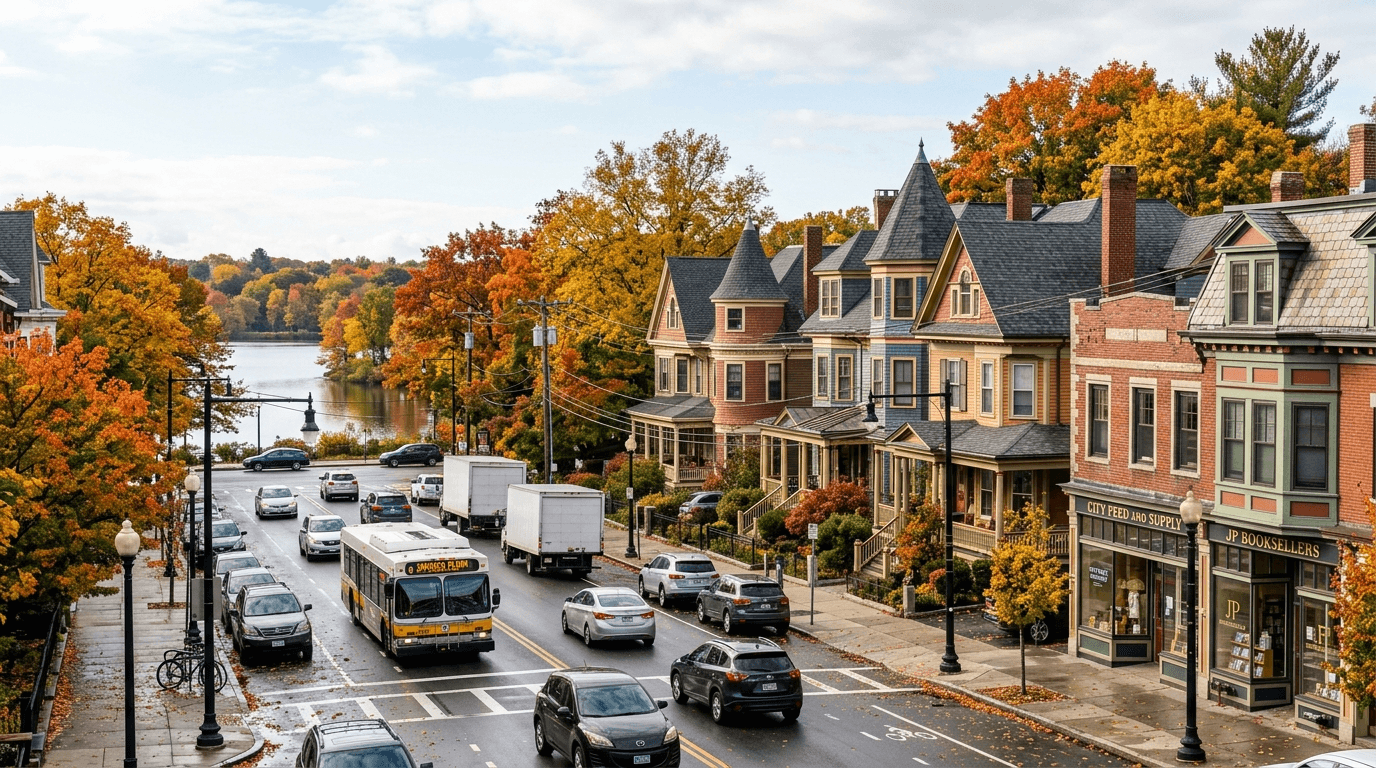
Allston's housing stock is a mix of historic brick row houses, converted triple-deckers, and a growing wave of sleek new mid-rise condo developments — with a strong tilt toward rentals and low-maintenance, shared-space living. You won't find sprawling lawns here. Think balconies, shared courtyards, and efficient urban footprints.
Allston Housing Tenure: Renters vs Owners
Allston is primarily a renter neighborhood, which supports a young-professional lifestyle with more rental inventory, roommate households, and flexible housing options.
TOTAL
Rent
87%
Own
13%
Allston is primarily a renter neighborhood, which supports a young-professional lifestyle with more rental inventory, roommate households, and flexible housing options.
If there's one thing to understand about this market, it's the tenure split: 87% rent and only 13% own. That renter dominance means plenty of rental inventory, lots of roommate-friendly multi-bedroom units, and flexible options across the board. The flip side? When quality for-sale condos hit the market, competition heats up fast.
On the rental side, the average Allston rent sits at $3,062, comfortably below the broader Boston average of $3,263. That gap is precisely why Allston keeps winning over young professionals who want city access without the downtown premium.
Allston Average Rent by Unit Size: 2025 vs 2026
Allston’s rental market is not moving uniformly: studios, 3-bedrooms, and 4-bedrooms softened year over year, while 1-, 2-, and 5-bedroom units rose—useful context for roommates, couples, and future family planning.
The rent picture isn't moving in a single direction, and the chart makes that clear. Studios softened from $2,166 to $2,104, while 1-bedrooms rose to $2,525 (up 2.56%) and 2-bedrooms climbed to $3,370 (up 3.60%). Larger units are more of a mixed bag: 3-bedrooms dipped slightly to $3,768 and 4-bedrooms eased to $4,655, but 5-bedroom units actually rose from $5,635 to $5,722. In plain terms, couples and roommate pairs are paying more, the biggest group houses still command top dollar, and solo studio renters have caught a small break.
One more practical note for renters. Following the recent legislative changes on broker fees, most Allston landlords still charge a full fee — but the no-fee segment is meaningful.
$67 millionGrant for 14 Green Line Stops
Green Line Accessibility Upgrade Plan
Green Line accessibility upgrades are especially relevant for Allston residents who rely on the B Branch. The MBTA’s plan targets 68 of 70 Green Line stops as accessible by 2031, supported by a $67 million federal grant for 14 B and C Branch stops.
On fees specifically, the Boston Pads 2026 report shows 78.75% of Allston owners charging a full fee, with roughly one in five listings (19.16%) advertised as no fee. When I'm advising renters, I tell them to target that no-fee segment early in the search — it can save you the equivalent of a full month's rent.
What Are the Best Community Hubs and Landmarks in Allston?
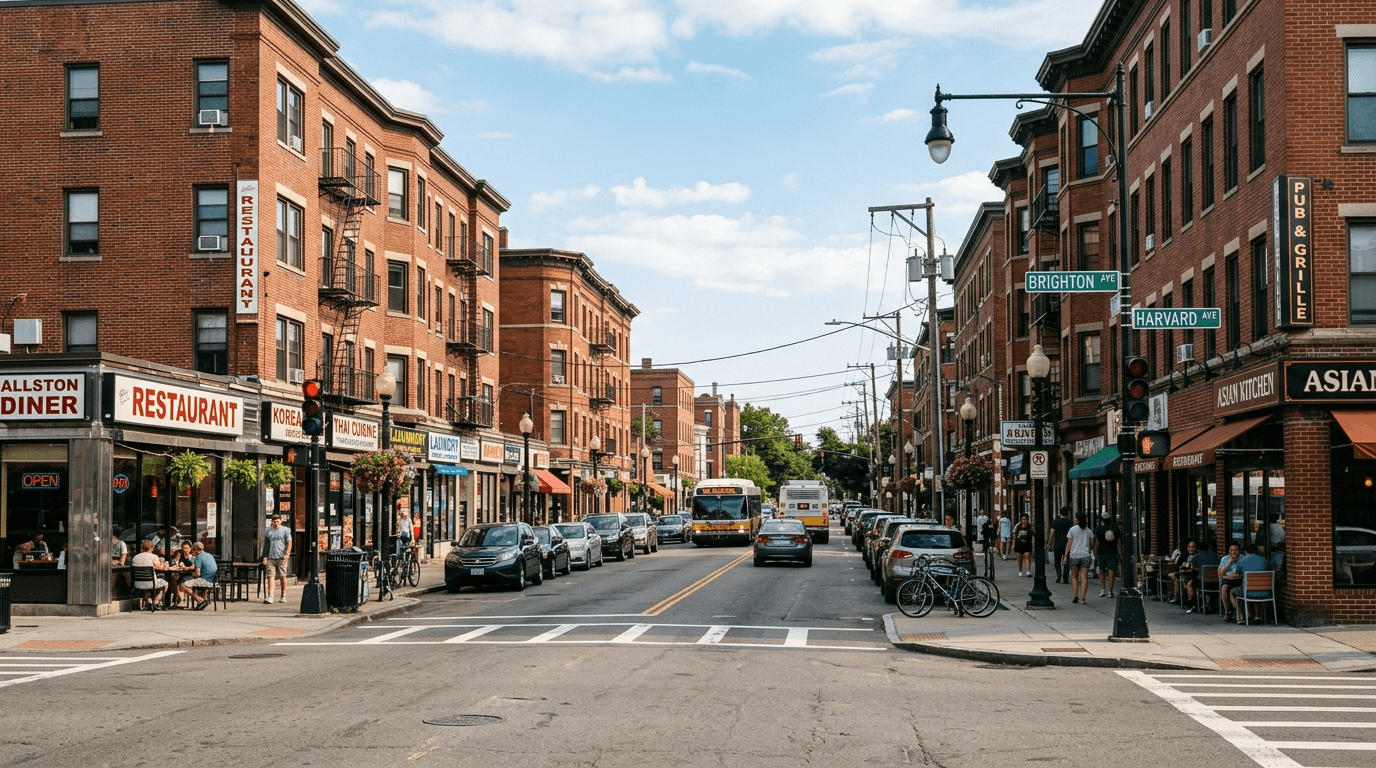
Allston's gravity centers on Brighton Avenue and Harvard Avenue — the culinary and cultural spine of the neighborhood — supported by green space along the Charles River and community anchors like the local library. This is where the neighborhood actually comes together.
The dining scene is the headline attraction, and it's genuinely global. Korean, Japanese, Burmese, Brazilian, and Chinese kitchens sit shoulder to shoulder. A destination like Qiao Lin Hotpot pulls people in from across the city, while everyday spots like Hokkaido Ramen Santouka Allston keep the corridor humming on weeknights. When clients ask what living here feels like day to day, I usually just point at the restaurant density — you can eat your way around the world inside a ten-minute walk.
On the family and community side, the Honan-Allston Branch of the Boston Public Library serves as a true neighborhood anchor, with programming, quiet workspace, and a gathering point that grounds the residential streets. Grocery access is strong too. A well-loved Trader Joe's functions as a reliable daily-life hub.
Green space rounds out the picture. The Charles River Reservation gives residents running paths and open space right at the neighborhood's edge — a big reason Allston earns that A+ outdoor activities grade despite its dense, urban footprint.
How Is the Commute From Allston to Boston and Cambridge?
Allston earns an A+ commute grade because it combines the MBTA Green Line 'B' Branch, frequent bus routes toward Cambridge and Brookline, direct highway access via I-90, and the Boston Landing commuter rail station. For young professionals, that kind of connectivity is a core selling point.
The Green Line B Branch is the backbone, with well-used stops at Harvard Avenue and Packards Corner threading you straight through Boston University and toward downtown. Bus service fills in the gaps. The 66 route in particular is a workhorse, linking Allston to Harvard Square and Brookline, while the 57 carries riders along the main commercial spine.
For regional commuters, Boston Landing adds commuter rail access on the edge of the neighborhood, and I-90 (the Mass Pike) puts you on the highway network within minutes. Subway, bus, rail, and highway all in one spot — that combination is rare inside city limits, and it's one of the strongest arguments for buying or renting here.
$67 millionGrant for 14 Green Line Stops
Green Line Accessibility Upgrade Plan
Green Line accessibility upgrades are especially relevant for Allston residents who rely on the B Branch. The MBTA’s plan targets 68 of 70 Green Line stops as accessible by 2031, supported by a $67 million federal grant for 14 B and C Branch stops.
The one thing to watch is the ongoing Green Line accessibility program. The MBTA's plan targets 68 of 70 Green Line stops as accessible by 2031, currently sitting at 45 accessible stops (64%), supported by a $67 million federal grant covering 14 B and C Branch stops. For Allston's B Branch specifically, construction is slated to begin in Summer 2027, with completion projected for Fall 2028. If you're moving here in the next couple of years, expect some station work in progress — but the long-term payoff is a materially better everyday commute.
Allston isn't for everyone, and I'll always be straight with clients about that. If you want a driveway and a big yard, this is the wrong neighborhood. But if you're after walkable energy, an unmatched food scene, transit in every direction, and rents that undercut the Boston average, few places in the city can compete. It's a neighborhood built for people early in their careers — and, increasingly, for the ones who decide to stay.
Is Allston in Boston, MA a good neighborhood for young professionals?
Allston is one of Boston’s strongest neighborhoods for young professionals, with an urban feel, A+ grades for nightlife, commute, and outdoor activities, and a #2 of 23 ranking among Boston neighborhoods for young professionals. It is lively along Brighton Avenue and Harvard Avenue, while nearby side streets tend to feel quieter and more residential.
Is Allston in Boston, MA good for families?
Allston has an A- grade for being good for families and increasingly appeals to young professional couples and small families who want to stay in the city. The Honan-Allston Branch of the Boston Public Library, Trader Joe’s, and access to the Charles River Reservation help support daily family life in a dense urban setting.
What are condos and townhomes like in Allston, Boston, MA?
Allston’s housing includes historic brick row houses, converted triple-deckers, and newer mid-rise condo developments. The neighborhood is built around low-maintenance urban living, with balconies, shared courtyards, and efficient layouts rather than large yards or driveways.
Is Allston, Boston, MA mostly rentals or owner-occupied condos?
Allston is heavily renter-oriented, with 87% of residents renting and 13% owning. This creates abundant rental inventory and roommate-friendly options, but quality for-sale condos can be competitive when they become available.
Is Allston, Boston, MA affordable compared with other parts of Boston?
Allston’s average rent is $3,062, which is below the broader Boston average of $3,263. Studios average $2,104, one-bedrooms average $2,525, two-bedrooms average $3,370, and larger shared units can command significantly higher prices.
Do renters in Allston, Boston, MA usually pay broker fees?
Most Allston landlords still charge a full broker fee, with 78.75% of owners charging a full fee. About 19.16% of listings are advertised as no-fee, making early searches important for renters trying to reduce upfront costs.
How is the commute from Allston, Boston, MA to downtown Boston and Cambridge?
Allston has an A+ commute grade because it offers the MBTA Green Line B Branch, frequent bus routes, Boston Landing commuter rail access, and quick access to I-90. The Green Line serves stops such as Harvard Avenue and Packards Corner, while the 66 bus connects to Harvard Square and Brookline and the 57 runs along the main commercial corridor.
What should families know about schools and education culture in Allston, Boston, MA?
Allston has a highly educated resident base, and education helps shape the neighborhood’s culture, cafes, and co-working energy. For family life, the neighborhood also has an A- grade for being good for families and is anchored by community resources such as the Honan-Allston Branch of the Boston Public Library.