Cambridge, MA Neighborhood Guide for Young Professionals: Condos, Squares, and Car-Light Living
Cambridge, MA guide for young pros: 88 Walk Score, 96 Bike Score, Red Line access, $955K condos, and Kendall/Central/Harvard Square vibes.
Written ByArthur Deych
PublishedJuly 24, 2026
UpdatedAugust 17, 2026
We're AD Advisors, a Brookline, MA real estate team led by Arthur Deych, serving buyers, sellers & investors across Greater Boston. Let's find your next move. Serving Brookline, Winthrop, Norwood, Watertown, Waltham, Revere, Medford, Ashland, Framingham, Dedham, Newton, Somerville, Needham, Boston, Cambridge and Westwood, MA.
Cambridge, MA
Region
In July 2026, the median sale price for homes in Cambridge, MA was $1,045,000, up 1.5% from a year earlier.
Cambridge is one of those rare places where a Nobel laureate, a Series-A founder, and a first-year grad student might all be waiting in line for the same cold brew. If you're a young professional weighing your first real Boston-area home purchase, this guide is for you. Consider it a straight look at the vibe, the housing, the social hubs, and the commute — all grounded in the numbers that actually matter right now.
What Is the Vibe Like in Cambridge, MA for Young Professionals?
Cambridge is high-energy, intellectual, and unapologetically busy — a walkable city of roughly 116,000 residents that runs on innovation and never fully powers down. If you want a car-optional lifestyle where there's always something happening, this is the center of gravity in Greater Boston.
The engine here is talent. Harvard and MIT anchor a full-time student population of about 42,000, and the surrounding ecosystem includes 1,000+ biotech and tech companies. That density of brainpower shows up everywhere — in the pace of the sidewalks, the packed calendar of lectures and meetups, and the sheer number of people building things.
Here's what I tell clients relocating from quieter suburbs: Cambridge trades square footage for proximity. You give up the yard, but you gain a world where your lab, your gym, your favorite ramen spot, and the Red Line all sit within a ten-minute walk. The social scene reflects that. Craft breweries, independent venues, and cafés like Cà Phê Collective double as informal co-working spots and networking hubs.
It's also genuinely livable, not just busy. Cambridge scores 83/100 on livability, ranks in the 93rd percentile nationally, and posts overall crime rates about 22% lower than the national average. Add a low 3.40% unemployment rate, and you have a city that feels dynamic without ever tipping into chaos.
What Are Condos and Townhomes Like in Cambridge, MA?
Cambridge is fundamentally a condo-and-townhome market, and that's exactly where young professionals should focus. Condos are the most accessible ownership segment, and they carry by far the deepest pool of listings.
As of June 2026, the condo/townhouse segment posted a median sold price of $955,000, with a median of 22 days on market and 8.2 months of supply across 432 active listings. Compare that to single-family homes, which sold at a median of $2,460,000 with just 14 days on market and 85 active listings. The gap is dramatic — and it tells you exactly where a first-time buyer actually has room to shop and negotiate.
Median Sold Price by Property Type: Cambridge
Condos remain the most accessible ownership segment in Cambridge by median sold price, while single-family and multi-family properties sit above $2M.
Condos remain the most accessible ownership segment in Cambridge by median sold price, while single-family and multi-family properties sit above $2M.
That deeper condo inventory matters more than people expect. In the ultra-competitive single-family tier, homes fly off the market. In the condo tier, buyers get more options and more breathing room.
Where the Inventory Is: Active Listings by Segment
For buyers who want an urban lifestyle with more options, the condo/townhouse segment carries the deepest listing pool in Cambridge.
For buyers who want an urban lifestyle with more options, the condo/townhouse segment carries the deepest listing pool in Cambridge.
Architecturally, Cambridge reads like a living timeline. You'll find classic Federal and Victorian townhomes, block after block of triple-decker two- and three-family conversions (the city has thousands of two- and multi-family dwellings on its rolls), and — especially near Kendall — sleek glass-and-steel high-rises with rooftop decks and concierge service. Lots are compact by design. This is dense urban living, where shared courtyards and private roof decks stand in for backyards.
One thing I always flag for buyers coming from single-family suburbs like Newton or Watertown: budget beyond the purchase price. Condo HOA dues in Cambridge range from around $250/month for simple, self-managed associations to $700+/month in amenity-rich buildings with gyms, doormen, and shared lounges. On the tax side, the FY2026 residential rate is a modest $6.67 per $1,000, which pencils out to roughly $5,803/year on a median-priced home.
Monthly Cost Reality Check for Cambridge Condos
Beyond the purchase price, Cambridge condo buyers should budget for monthly HOA dues and city property taxes—especially in amenity-heavy buildings.
For the broader picture: the "all other types" segment posted a median sold price of $1,200,000 as of June 2026. And according to a separate May 2026 market report, the citywide median sale price came in at $1,170,000, homes moved in a median of 20 days, the sale-to-list ratio held at 100.0%, and 49% of homes sold at or above asking.
Cambridge Market Pulse: Headline Numbers
A quick read on Cambridge’s competitive, high-cost market: properties moved in about 20 days, nearly half sold at or above asking, and the median sale-to-list ratio held at 100%.
That 100% sale-to-list ratio is the number to internalize. In Cambridge, you should generally expect to pay close to ask — and be ready to move quickly, with a typical earnest money deposit of 2–3% and a closing window of 30–60 days.
Where Do People Gather in Cambridge, MA? Key Landmarks and Social Hubs
Cambridge's social life clusters around three squares — Kendall, Central, and Harvard — plus the Charles River corridor. Each has its own distinct personality, and where you buy often comes down to which one feels like home.
Kendall Square is the professional epicenter, often called "the most innovative square mile on the planet." It's where biotech and tech converge, and it's where major lab tenants like Sanofi and AbbVie have signed enormous leases. If you work in the industry, buying here means walking to the office. Formaggio Kitchen Kendall is the kind of specialty grocer that anchors the after-work crowd.
Central Square is the grittier, more eclectic heart of the city — live music at spots like The Cantab Lounge , an outstanding and diverse dining lineup, and a real neighborhood feel. It tends to draw younger professionals who want energy and value in the same zip code.
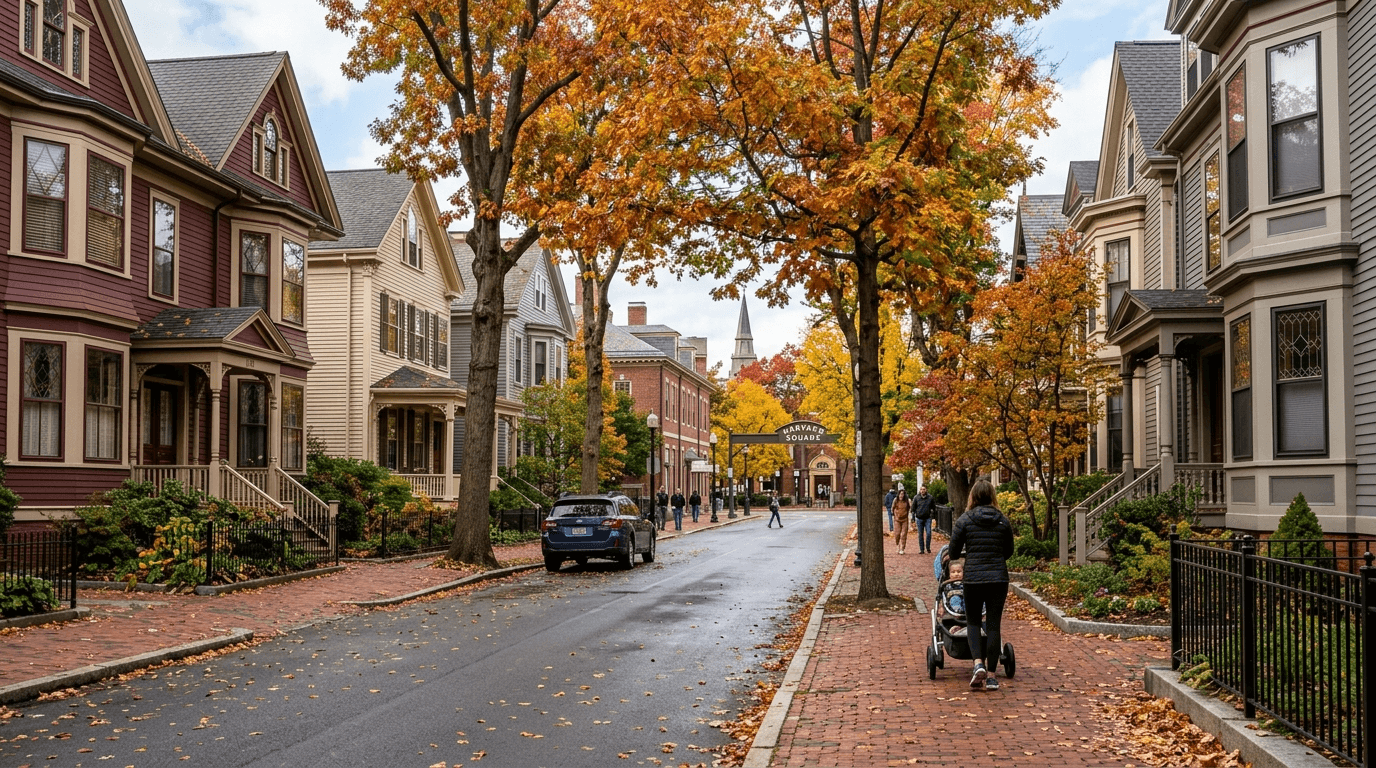
Harvard Square delivers the classic collegiate Cambridge — independent bookstores, historic architecture, and a steady buzz of visitors and students.
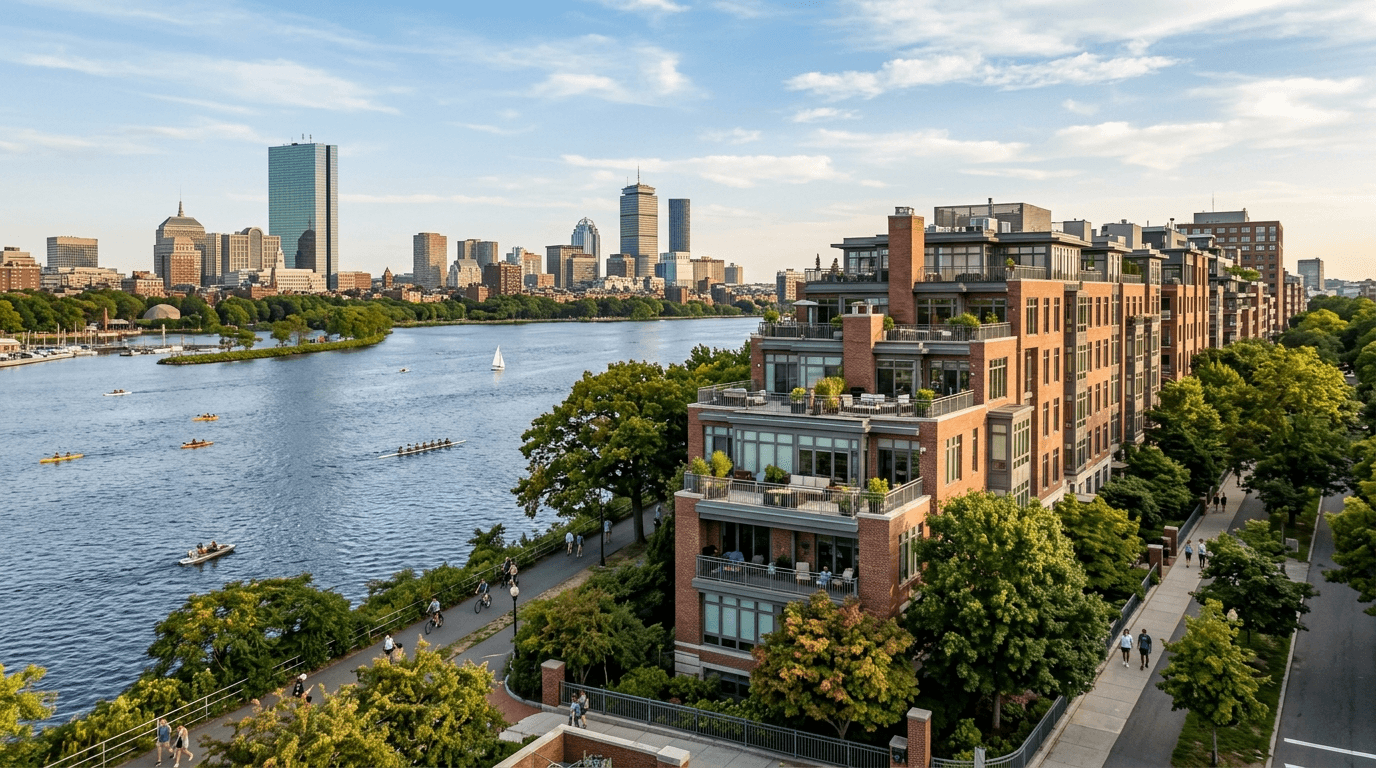
And running along the southern edge, the Charles River Esplanade gives residents miles of paved paths for running and cycling. With 80 parks and open spaces citywide, the outdoor life here is better than most newcomers expect from a city this dense.
How Is the Commute From Cambridge, MA to Boston?
Cambridge is built for a car-light life. The commute into downtown Boston can be under 20 minutes by subway, and you may not need a car at all.
The mobility scores tell the whole story: a near-perfect Bike Score of 96/100, a Walk Score of 88/100, and a Transit Score of 74/100.
Cambridge Mobility Scores
Cambridge fits a car-light lifestyle: elite bikeability, strong walkability, and solid transit access support the urban, always-on appeal for young professionals.
Cambridge fits a car-light lifestyle: elite bikeability, strong walkability, and solid transit access support the urban, always-on appeal for young professionals.
The backbone is the MBTA Red Line, with key stops at Kendall/MIT, Central, Harvard, and Porter. Any of these gets you into Boston's financial district fast — the subway ride runs under 20 minutes, driving is roughly 11–15 minutes off-peak, and even biking downtown takes under 30 minutes. When I'm advising buyers, I tell them to pick their square partly by which Red Line stop they'd use daily. Proximity to a station meaningfully shapes both quality of life and resale.
Beyond the Red Line, the Bluebikes bike-share network is dense and heavily used, backed by extensive dedicated bike lanes and a city government genuinely committed to pedestrian and cyclist infrastructure. For the times you do drive, Memorial Drive, Route 2, and Interstate 90 (the Mass Pike) provide quick regional access — though be warned, parking garage rates in the busy squares run $15–$30/day, which is one more reason most residents lean into transit.
The bottom line for young professionals: Cambridge rewards buyers who understand its numbers. Condos are your entry point, the squares define your lifestyle, and the Red Line makes a car optional. It's a competitive market where homes trade near asking and move fast, so the buyers who win here are the ones who come in informed, pre-approved, and ready to act. If you'd like a data-driven read on a specific building or square, that's exactly the kind of homework worth doing before you tour.
Is Cambridge, MA a good place for families to live?
Cambridge, MA is highly livable, with a livability score of 83/100 and a national ranking in the 93rd percentile. It is dense and busy, but residents have access to 80 parks and open spaces, the Charles River corridor, walkable squares, and overall crime rates about 22% lower than the national average.
What are schools and education like in Cambridge, MA?
Cambridge, MA is anchored by Harvard and MIT, which support a full-time student population of about 42,000. The city has a strong intellectual and academic culture, with lectures, meetups, cafés, and innovation-focused activity woven into daily life.
Are condos and townhomes common in Cambridge, MA?
Cambridge, MA is primarily a condo-and-townhome market, making these properties the main ownership option for many buyers. As of June 2026, condos and townhomes had a median sold price of $955,000, 432 active listings, and a median of 22 days on market.
How much do condos cost in Cambridge, MA?
Buying a condo in Cambridge, MA typically costs less than buying a single-family home, but it is still a high-cost market. As of June 2026, the median sold price for condos and townhomes was $955,000, compared with $2,460,000 for single-family homes.
How much are HOA fees for condos in Cambridge, MA?
Cambridge, MA condo HOA dues generally range from about $250 per month in simple, self-managed associations to $700 or more per month in amenity-rich buildings. Buildings with gyms, doormen, shared lounges, rooftop decks, or concierge service usually carry higher monthly fees.
Is Cambridge, MA good for commuting to Boston?
Cambridge, MA is built for a car-light lifestyle, with a Walk Score of 88/100, Bike Score of 96/100, and Transit Score of 74/100. The MBTA Red Line serves Kendall/MIT, Central, Harvard, and Porter, with subway rides into downtown Boston taking under 20 minutes.
Do you need a car in Cambridge, MA?
Many residents in Cambridge, MA do not need a car for daily life because the city is highly walkable, bike-friendly, and well served by transit. Bluebikes, dedicated bike lanes, and Red Line access support a car-optional lifestyle, while parking in busy squares can cost about $15–$30 per day.
Is Cambridge, MA an affordable place to buy a home?
Cambridge, MA is competitive, but condos give buyers more room to shop than single-family homes. The citywide May 2026 median sale price was $1,170,000, homes sold in a median of 20 days, the sale-to-list ratio was 100.0%, and 49% of homes sold at or above asking.