
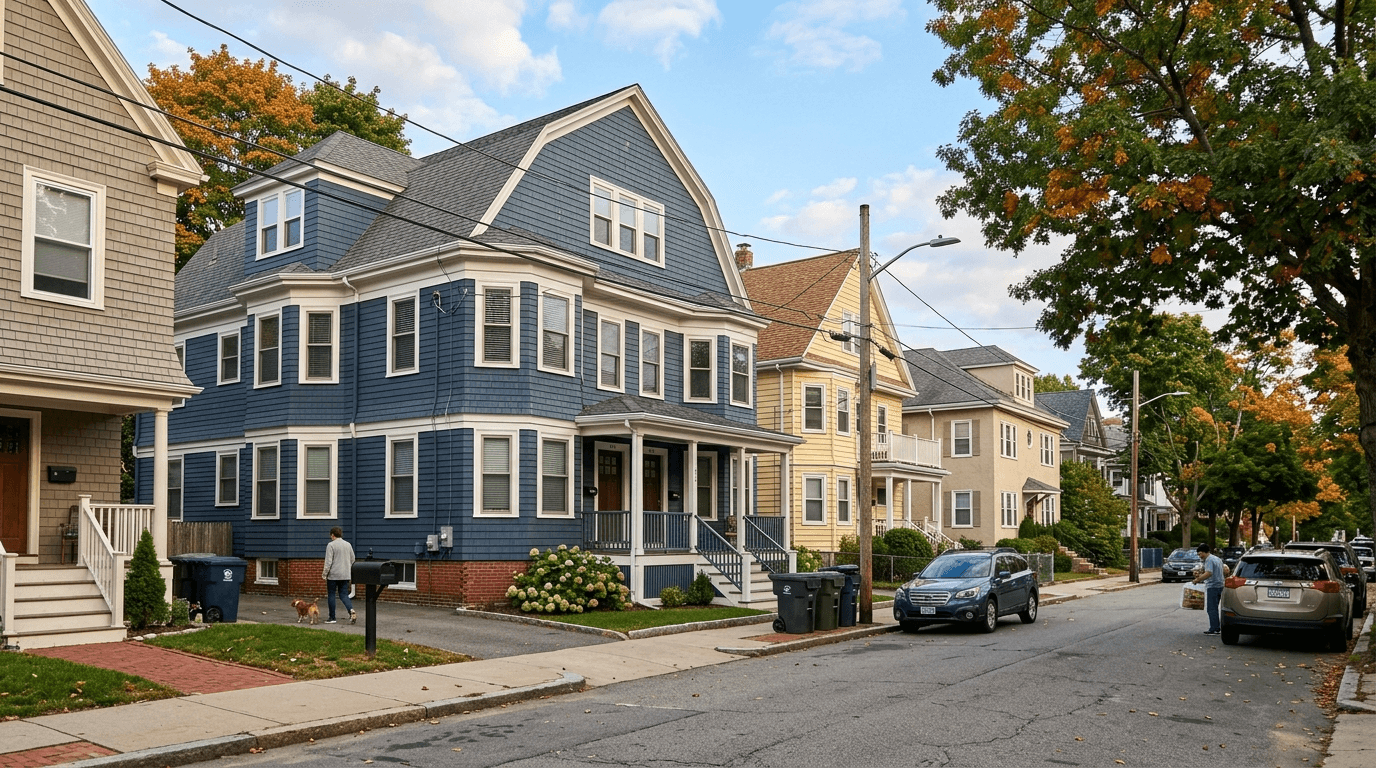
Could Watertown's Residential Tax Exemption Cut Thousands Off Your Tax Bill?
Key Takeaways
•The answer: If you own and live in your Watertown home, the FY2026 residential exemption cuts $3,961.52 off your tax bill, according to Vision Government Solutions' FY2026 Watertown tax data.
•How it works: The city subtracts a fixed $324,715 of assessed value first, then applies the $12.20 per $1,000 residential rate.
•The catch: Owner-occupancy is the test the Assessors apply, and the benefit is not something to assume transfers with a sale. Confirm filing rules and deadlines with the Board of Assessors — and budget the full, non-exempt bill for property you will not live in.
Why Can the Same Watertown Home Have Two Different Tax Bills?
Same house, same street, two totally different price tags at tax time. The whole thing hinges on one question: do you own it and actually live there as your main home?
FY2026 runs July 1, 2025 through June 30, 2026. Qualified owner-occupants save $3,961.52 for the year — roughly $330 a month sitting in escrow, the account your lender uses to cover your property taxes.
Plug the owner-occupant number into a property you won't live in, and your pro forma — your projected income-and-expense math — is broken before you even close.
How Does Watertown Calculate the Savings?
Watertown subtracts a fixed amount from your assessed value — the number the city assigns your home for tax purposes — then applies the residential rate.
Watertown FY2026 Property Tax Snapshot
Primary-source FY2026 Watertown tax rates and residential exemption figures approved by the Department of Revenue.
FY2026 Tax Inputs
Residential Tax Rate$12.20 / $1,000
Commercial Tax Rate$23.47 / $1,000
Residential Exemption
Residential Value Exclusion$324,715
Residential Tax Exclusion$3,961.52
Source:Vision Government Solutions
The FY2026 formula:
(Your assessed value − $324,715) ÷ 1,000 × $12.20
Take a home assessed at $800,000. The city taxes it on $475,285, landing at a bill of about $5,798.
The exemption shrinks the taxable amount, not the rate itself. Eligibility comes down to where you actually live, so confirm what documentation the Assessors want before you file.
How Do Massachusetts Homeowners Lose the Exemption by Accident?
1. They don't live in the property. Owner-occupancy is the test. If the home isn't your principal residence, don't count on it.
2. They buy after seeing the seller's lower bill. That low number might reflect the seller's exemption, not yours. Ask the Assessors how your closing date affects eligibility for the current fiscal year.
3. They assume it's automatic. Deadlines and application rules belong to the Board of Assessors — call before you guess a date, and check the exemption line every single year.
4. They hold the home in a trust. Trust ownership raises real eligibility questions. Ask the Assessors how trusts get treated before assuming the exemption carries over.
What Are the Strongest Arguments Against Caring About This?
"Is $3,961.52 a year really meaningful in Greater Boston?"
Against a Greater Boston purchase price, sure, it's small — and it rarely flips a buying decision on its own. But it's not a one-time thing.
Average Watertown Residential Tax Bill: Exempt vs Non-Exempt
Watertown News-reported average FY2026 residential bills and year-over-year increases for non-exempt and exempt households.
Average Bill
Year-over-Year Change
| Series | Label | Value |
|---|---|---|
| Average Bill | Non-Exempt Residential Bill | $11,328 |
| Average Bill | Exempt Residential Bill | $7,363 |
| Year-over-Year Change | Non-Exempt Residential Bill | $734 |
| Year-over-Year Change | Exempt Residential Bill | $476 |
Across all residential property types, a Watertown brokerage analysis puts the average non-exempt bill at $11,328, versus $7,363 for exempt properties. That gap hits your operating-expense line every year you own the place, and it moves two numbers that matter most: your monthly payment estimate and your budgeted expenses. On a rental that barely breaks even, that gap decides the whole year.
"What about owner-occupied two- and three-families?"
Fair pushback, and it sharpens the point above. Owner-occupancy — not whether rent is coming in — is what the Assessors actually check. Living in one unit while renting the others? Get it in writing before you build it into your numbers: (617) 972-6410 or assessors@watertown-ma.gov.
"What if I live there part-time and also rent it short-term?"
Part-time occupancy plus short-term renting doesn't automatically disqualify you. The real question is whether the home is your principal residence. You're probably not going to fail that test — the risk is that proving you pass it falls on you, and the Assessors decide what counts as proof.
What Should You Check Before Your Next Tax Bill?
Pull your latest Watertown tax bill and find the residential exemption line. Then check three things:
•Is the home your principal residence?
•Do your records back that up?
•Is your mortgage escrow using the right tax number?
If that exemption line is missing, your lender might be collecting way more than it should each month.
Send over the address and your latest tax record, and we'll walk through the real monthly number before it catches you off guard.